Wall Sheathing Rot and Moisture Damage Repair
Sheathing rot repair for Calgary homes. When old siding, stucco or capping comes off over soft OSB or plywood, we cut back to sound wood, replace sheathing, damaged studs and wet insulation, and fix the flashing or clearance fault that let the water in.
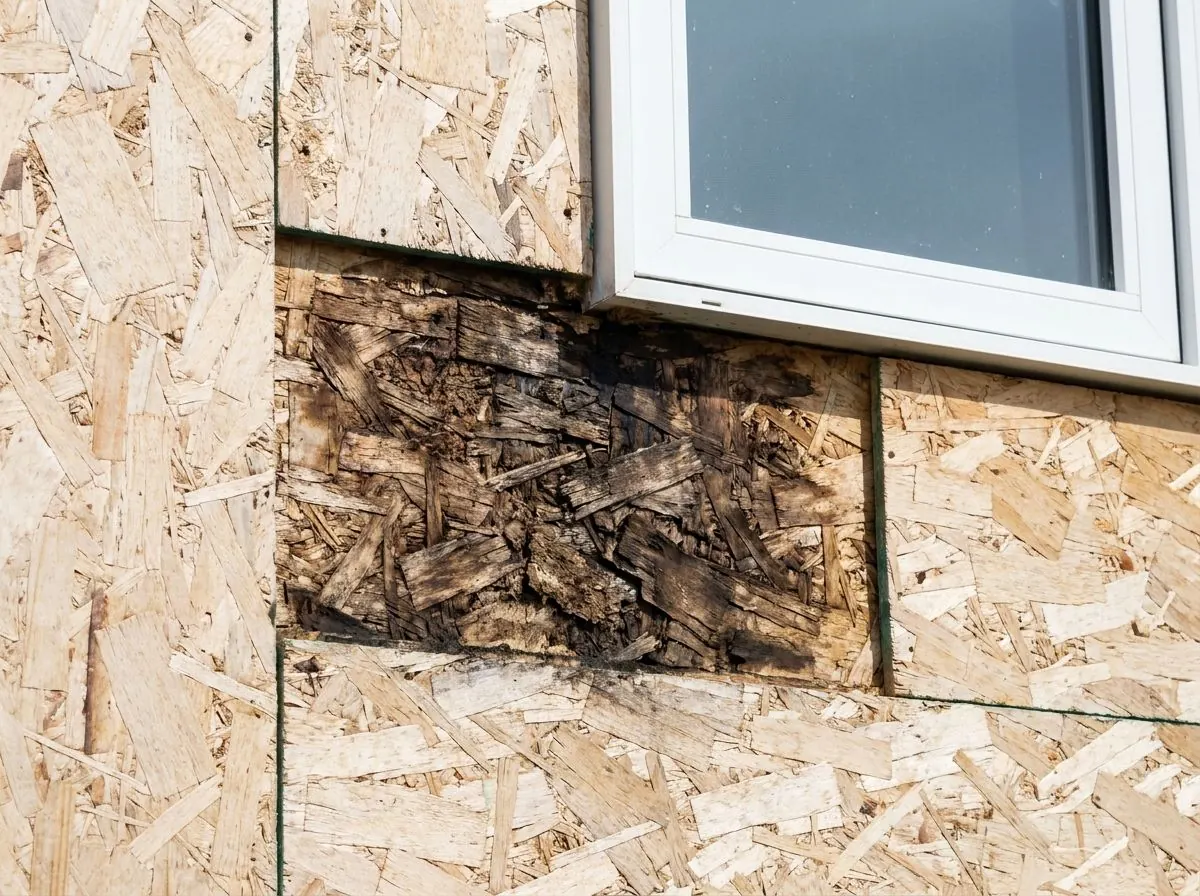
The Problem It Solves
Sheathing rot is usually found, not reported. The siding looks tired but whole, then a section comes off during a repair or re-side and the OSB behind it breaks apart in the hand, dark and soft, with nails pulling straight out. Siding hides it well: vinyl looks dry on its face, aluminum capping hides the wood it covers, and stucco can hold water against the wall while its surface looks sound. “Dry rot” is the everyday name, but the wood rotted because it stayed wet.
The water almost always comes from a detail rather than from rain landing on the open wall. A roof that meets a wall without a kickout flashing sends water behind the siding at the bottom of the roof line. A window with no head flashing, or failed sealant at the sill, feeds the wall below it. Stone veneer buried in landscaping, or siding run down to a deck or grade, wicks water into the sheathing. Each source leaves its own pattern: a triangle under a roof junction, a stripe below a window, a band along the base of the wall.
Left alone, rot moves past the sheathing. Studs soften at the bottom plate and under windows, insulation gets wet and stops insulating, and mould grows in the cavity. Sheathing also stiffens the wall, and new siding can’t be fastened properly to board that won’t hold a nail. LP’s installation instructions say plainly not to apply siding over rain-soaked or buckled sheathing, and the principle holds for every product: new cladding over a rotten wall buys a few years of looks and hides the problem again.
How It Works
The repair is a removal and a rebuild. We open the wall wider than the visible damage, probe sheathing and framing until we reach sound, dry wood, and cut back to framing lines so new panels land on solid support. Damaged studs are reinforced or replaced, wet insulation comes out, and cavities dry before they are closed. New sheathing goes on with gaps between panels; the City of Calgary’s climate-ready guidance says sheathing shouldn’t be tightly sealed, because those gaps let trapped moisture dry out. The same guidance says plywood has better water resistance and drying ability than OSB, which makes it worth considering on a wall that has already rotted once.
Then the water source gets fixed, because that is the real repair. Kickout flashings go in where roofs meet walls. Window heads get flashing that runs up behind the membrane and slopes out with a drip. Sheathing membrane is replaced and lapped so upper sheets shed over lower ones, and sealant goes back between siding and frames. The CCMC evaluation for James Hardie cladding puts moisture risk in the wall largely down to workmanship on the membrane, flashing, caulking and attachment, and calls a high level of quality control at every stage imperative.
How the Job Runs, Step by Step
Open and map the damage
We remove siding beyond the visible damage in every direction and mark the extent of soft sheathing and framing on the wall. It is worth asking for photos at each stage, so you can see what was found before anything is covered again.
Trace the water path
Rot follows water, so we follow the staining upward and outward to its source: a roof-wall junction, a window head or sill, a penetration, a buried base. If the source isn’t obvious, we investigate further rather than guess and close the wall.
Cut out and dry
Rotted sheathing is cut back to framing lines, wet insulation is removed and studs are assessed. Where framing damage goes beyond a local repair, we stop, explain what we found, and confirm the approach with the municipality before continuing.
Rebuild the substrate
Studs are repaired or replaced, cavities are re-insulated once dry, and new sheathing is fastened with gaps between panels. Where the interior vapour barrier is exposed, it is kept continuous on the warm side of the wall.
Membrane, flashing, cladding
Sheathing membrane is lapped at least 100 mm with upper sheets over lower, flashing is installed at the leak source, and cladding is reinstalled or replaced to the manufacturer’s instructions with proper clearance to grade and roof.
What Decides the Specification
How much comes out is decided by the wood, not by the estimate. Sheathing that is stained but firm and dry can stay; sheathing that is soft, delaminated or won’t hold a fastener comes out. Older homes often have board sheathing rather than panels, which changes how a patch ties into what remains. Thickness follows Article 9.23.17.2. of the NBC(AE) and has to suit the cladding going back on: James Hardie’s Canadian instructions, for example, allow HardiePlank to be fastened directly to OSB of at least 11.1 mm (7/16 in). The City of Calgary expects replaced components to perform as well as, or better than, what they replace.
The second driver is what goes over the new sheathing. Rigid foam isn’t a substitute; the City’s guidance says rigid insulation shouldn’t be used alone as wall sheathing because it doesn’t protect against high winds. Whether to add a rain screen is decided here too. The code doesn’t require one on a Calgary house, but on a wall that has already rotted, a drained gap behind the cladding is often worth it.
Alberta Code Notes
Alberta’s Permit Regulation exempts re-siding with a similar type of siding only where there is no structural change and health or safety isn’t at risk. Replacing sheathing and studs can count as a structural change, so a rot repair can take a job outside that exemption. The authority having jurisdiction decides, whether that is the City of Calgary, Airdrie, Okotoks, Cochrane or Chestermere, and we confirm before the wall is closed. The rebuilt wall still needs two planes of protection under the NBC(AE): the cladding, and a second plane that intercepts water getting past it and dissipates it to the exterior, with flashing at horizontal junctions and substrate changes.
Two code clearances bear directly on rot. Cladding adversely affected by moisture, such as untreated wood, plywood or OSB, needs 200 mm between it and finished ground, and 50 mm above a roof surface. On houses whose building application was submitted on or after November 1, 2016, the City of Calgary requires renovations to comply with the energy-efficiency requirements of Section 9.36, which shapes the insulation that goes back into opened cavities.
General guidance only. The authority having jurisdiction and the product’s own evaluation report decide what applies to your job.
Around Calgary
Rot turns up in every quadrant, but the causes differ by era. Post-war homes in communities such as Killarney/Glengarry often carry original sheathing behind stucco or later over-cladding, and every layer added is another place to trap water. 1960s and 1970s homes in areas like Lake Bonavista may have aluminum capping over wood fascia and window frames, which can hide rot until the wood is gone. Newer 2000s homes in Evergreen and Bridlewood aren’t exempt: missing kickout flashings and stone veneer bases set too close to landscaping are common sources of wall rot on houses of that age.
Often Done Alongside
Weather-Resistive Barrier (WRB) & Housewrap
Tyvek, building paper or self-adhered membrane, lapped, taped and flashed.
Rain Screen & Cavity Ventilation Systems
Furring or drainage mat leaving a drained, vented gap behind the cladding.
Hardie Board & Panel Sectional Repair
Cracked or failed Hardie boards, panels and trim replaced, and the cause fixed.
Where We Do This Work
Sheathing & Rot: Questions We Get
How can I tell if sheathing is rotten without removing siding?
Does sheathing rot repair need a permit?
Is plywood better than OSB for the replacement?
What happens if you find mould in the wall?
Can siding be installed in a Calgary winter?
Considering Sheathing & Rot?
Call Calgary Siding Solutions or send the details. We will look at the job, tell you whether sheathing & rot is the right fix, and price it in writing.