Replacing Hail-Damaged Siding After a Storm
Hail damage siding replacement across Calgary and nearby towns. We document cracked, holed and stripped walls for your adjuster, replace damaged Hardie board, vinyl, soffit and trim, and help you decide whether the rebuild should use a tougher cladding.
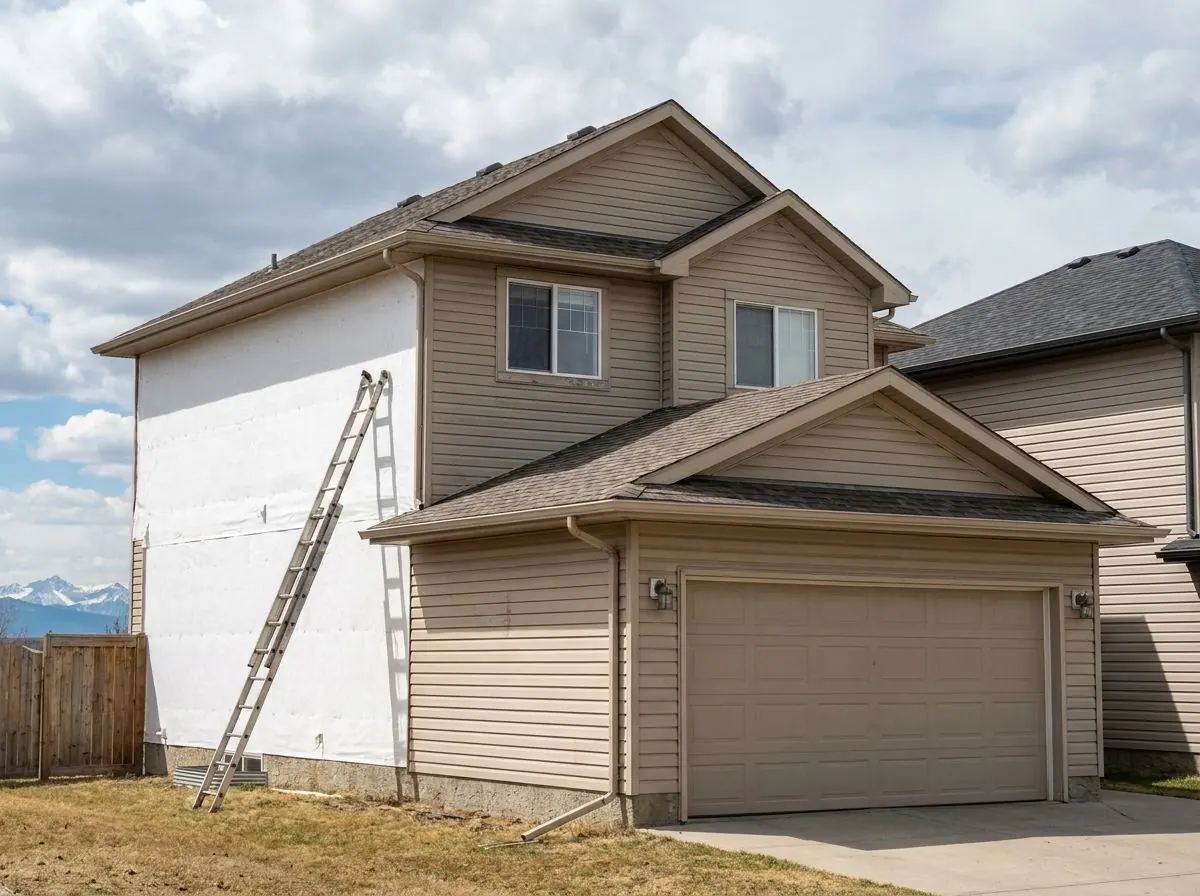
The Problem It Solves
Hail rarely falls straight down onto a wall. Wind drives it sideways, so the elevation facing the storm takes the hits while the wall opposite can look untouched. Vinyl cracks, punctures or splits. Aluminum dents. Fibre cement can chip at an edge or crack under large hail, and soffit panels crumple. In Calgary’s worst storms the damage went well past dents: reporting after the June 2020 storm described entire neighbourhoods in northeast Calgary with homes stripped of their siding and others left covered in holes.
A cracked panel is not only a cosmetic problem. Once the cladding, the first plane of protection, is holed, rain and melting snow reach the sheathing membrane behind it, and that membrane was never meant to be the only thing between the weather and the wall. Torn house wrap, loosened flashings and punctured J-channel are easy to miss from the lawn, which is why a quick look from the driveway rarely gives an adjuster the full picture.
Then there is the claim. Hail is typically covered under standard home insurance policies, but how a claim settles depends on your own policy. Some Alberta policies carry a roof-and-siding endorsement that settles vinyl or aluminum siding on an age-adjusted basis rather than full replacement cost. Vinyl profiles and colours get discontinued, and weathered panels fade, so new panels on one wall may not match the three walls that were spared. Whether undamaged walls are replaced to match is a question for your adjuster and your policy; we found no Alberta rule that settles it.
How It Works
Our work starts with a record, not a sales pitch. We walk every elevation, photograph the damage with a scale reference, measure each wall and identify the existing product where we can: vinyl profile, Hardie plank or panel, trim type, soffit. Where an exact colour or profile is no longer made, we note what is available and what isn’t. You get photos, measurements and a written scope you can give your adjuster. We don’t negotiate your claim, promise an outcome or touch your deductible. The claim is between you and your insurer, and the facts in our scope stay the same whatever the policy says.
Replacement is also a chance to choose differently, and it pays to be clear about what that buys. There is no industry hail rating for siding; UL 2218 and FM 4473 are roofing tests. What we can describe is how materials behave. The City of Calgary’s climate-ready guidance calls fibre cement one of the most resilient siding types for hail and wind, says cheaper vinyl can be easily damaged by hail, notes that aluminum dents without affecting the home’s integrity, and rates engineered wood’s impact resistance as good compared with vinyl and aluminum. Very large hail can still crack fibre cement, dent metal and chip engineered wood. The goal is fewer and smaller repairs next time.
When an upgrade makes sense, it is installed to the manufacturer’s published instructions. Hardie board fastened directly against the wall goes over asphalt-impregnated building paper, as the Canadian product evaluation calls for; where we use a synthetic housewrap, the planks go over a drained, vented furring cavity instead. LP SmartSide carries a limited hail-damage warranty, with hail-size limits set out in LP’s current warranty. For James Hardie’s terms, see James Hardie Canada’s current warranty.
How the Job Runs, Step by Step
Protect the open wall
We photograph first, then cover holes and missing panels with temporary membrane so the sheathing doesn’t take on rain while the claim is processed. The record shows the damage exactly as the storm left it, before anything was touched.
Assess each elevation
Every wall, soffit run, fascia line and trim piece is inspected and measured. Where possible we lift a sample panel to see the membrane behind, identify the product and profile, and note which walls faced the storm and which escaped.
Write the scope for your adjuster
You receive dated photos, measurements, a material list and a scope that separates hail damage from older wear. If a colour or profile is discontinued, the scope says so and lists the nearest available products, so the matching discussion starts from facts.
Tear off and repair the wall
Damaged cladding comes off down to the membrane. Torn membrane is replaced and lapped upper over lower, flashings at windows and horizontal junctions are checked, and any wet or damaged sheathing found underneath is repaired before new siding goes on.
Install, finish and photograph
New siding goes on with the clearances, fastening and joint details its manufacturer requires. Soffit, fascia and trim are finished and the site is cleaned. Photos of the completed elevations are worth keeping with your claim records.
What Decides the Specification
The first driver is the material, and what the policy and the house will support. A like-for-like vinyl replacement is the quickest path back to a sealed wall and usually the simplest claim. Premium vinyl lines are thicker, generally in the mid-.040-inch range, which makes panels stiffer and less wavy, but thickness alone doesn’t make vinyl hail-resistant. Moving to fibre cement, steel, aluminum or LP SmartSide changes the weight on the wall, the trim details and sometimes the permit question, and whether any upgrade is covered is between you and your insurer.
The second driver is how much of the house is really damaged. One cracked course on a sheltered wall is a repair. A storm-facing elevation of split panels is a wall replacement. A house hit on three sides with torn membrane and dented soffit is a whole-home re-side. Appearance matters too: if new panels won’t match faded originals, replacing a full elevation corner to corner often looks better than patching mid-wall.
Alberta Code Notes
Alberta currently enforces the National Building Code – 2023 Alberta Edition. Under Alberta’s Permit Regulation, replacing siding with a similar type of siding, for maintenance or appearance and with no structural change, is generally exempt from a building permit. Switching from vinyl to fibre cement or metal after a storm is a change of cladding type and can take the job outside that exemption, as can structural sheathing repairs. The City of Calgary treats exterior renovations case by case and Airdrie’s building inspections department makes its own call, so we confirm with the municipality before work starts. The Insurance Bureau of Canada has called for codes that require hail-resistant siding in high-risk areas; no such requirement exists today.
General guidance only. The authority having jurisdiction and the product’s own evaluation report decide what applies to your job.
Around Calgary
Calgary’s hail record is not spread evenly. The June 13, 2020 storm’s core damage area covered roughly 10 to 15 square kilometres just east of the airport in northeast Calgary, with Taradale reported among the worst-hit neighbourhoods, and the same storm reached Airdrie. The August 5, 2024 storm tracked across northern Calgary, with damage reported in Sage Hill in the northwest and Redstone in the northeast; an initial survey counted about 35,000 buildings damaged in and around the north of the city. The south has its own event: on July 15, 2023, hail damaged siding and roofs in Calgary’s south-centre neighbourhoods.
Often Done Alongside
Hardie Board & Panel Sectional Repair
Cracked or failed Hardie boards, panels and trim replaced, and the cause fixed.
Premium Heavy-Gauge Vinyl Siding
Thicker vinyl panels, hung loose to ride out Calgary’s temperature swings.
HardieBoard & HardiePlank Lap Siding
Smooth or wood-grain fibre cement lap planks, laid out course by course
Where We Do This Work
Hail Damage: Questions We Get
Will insurance replace all my siding if only one side was hit?
Will fibre cement come through the next big storm undamaged?
How soon after a storm should the siding be looked at?
Should I replace hail-damaged vinyl with vinyl again?
How do I know the siding was installed properly?
Considering Hail Damage?
Call Calgary Siding Solutions or send the details. We will look at the job, tell you whether hail damage is the right fix, and price it in writing.