Weather-Resistive Barriers and House Wrap Behind Siding
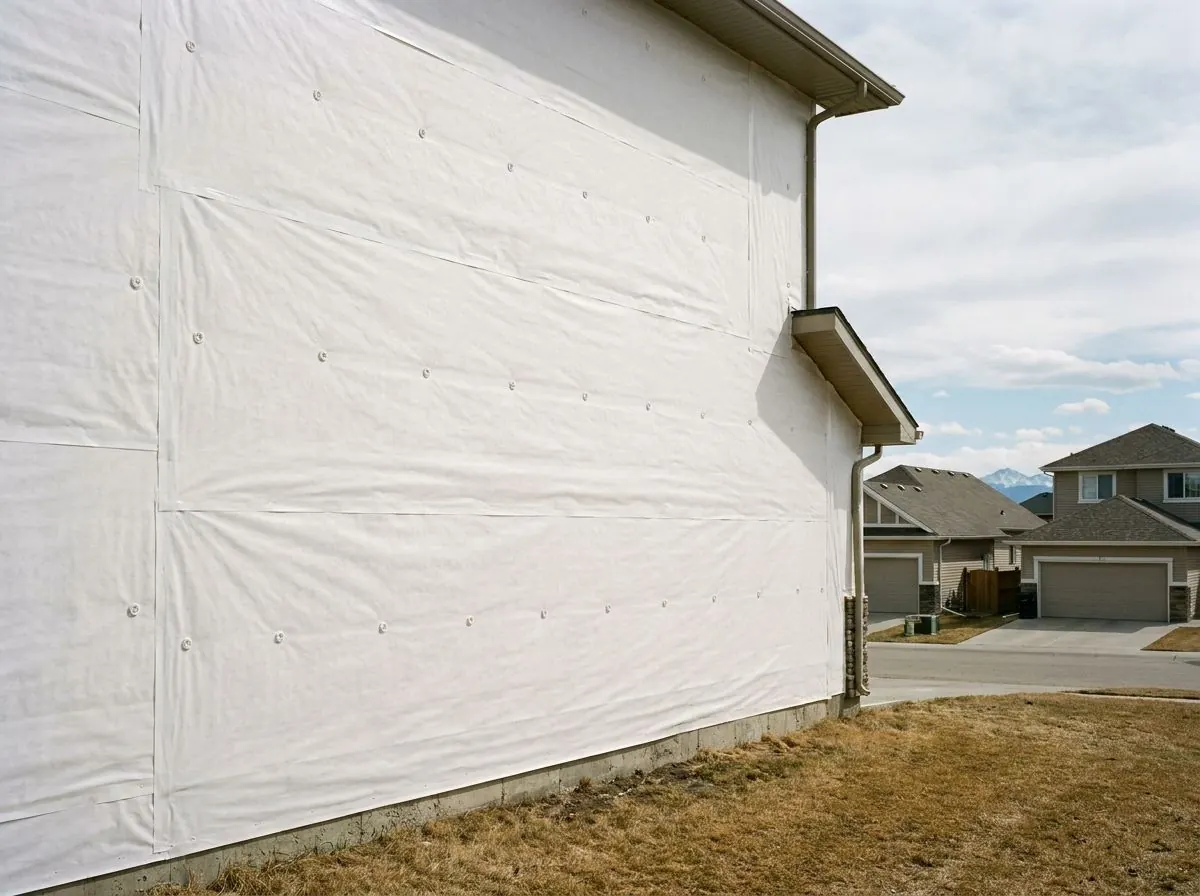
On a Calgary house the barrier behind the siding is what stops wind-driven rain that gets past the cladding. With the old siding off, we repair the sheathing and install Tyvek HomeWrap, building paper or a self-adhered membrane matched to the cladding going on.
The Problem It Solves
Siding is not waterproof, and the building code doesn’t expect it to be. The cladding, with its trim and fasteners, is the first plane of protection. Water will get past it at laps, butt joints, corners and trim, especially when wind drives rain sideways; Calgary’s design table lists a driving-rain wind pressure of 220 Pa. The second plane, the membrane on the sheathing, has to catch that water and send it back outside. When it can’t, water reaches the sheathing, and the first sign is often a stain on drywall or a soft spot under a window.
When old siding comes off, the barrier underneath tells the story of the wall. The common failures are wrap lapped the wrong way, so a lower sheet overlaps the one above and funnels water behind it; wrap torn by staples or old repairs; window head flashing tucked behind the membrane instead of over it; missing kickout flashing where a roof edge meets a wall; and wrap left in the sun so long it degraded before the cladding went on. None of it shows from the street.
The other problem is a barrier that doesn’t suit the cladding. Canada’s product evaluation for James Hardie siding says the direct-applied planks were not evaluated in contact with polymer-based membranes and calls for asphalt-impregnated building paper. Tyvek’s evaluations require a 10 mm air space between the wrap and the cladding, unless the cladding is deemed not to need one. Manufactured stone veneer, under its manufacturer’s instructions, goes over two layers of water-resistive barrier. A wrap that is excellent behind one cladding can put another outside its evaluated installation.
How It Works
A working barrier is built like a roof, from the bottom up. Each sheet laps over the one below by at least 100 mm, so water on its face always runs outward and down. The City of Calgary notes that unsealed, vapour-permeable air barriers are typically installed over sheathing here: the membrane sheds liquid water while letting vapour escape outward, and the vapour barrier stays on the warm side of the wall. Seams and the membrane around windows and doors are taped as the manufacturer’s evaluation requires.
Openings are where barriers fail, so they get their own sequence. Sill flashing goes in first, then jamb membrane lapping over it, then head flashing slipped under the wrap above so the upper sheet overlaps it. Flashing turns up at least 50 mm behind the membrane, slopes outward, and has end dams and a drip. For the barrier material, we match the cladding: building paper behind direct-applied HardiePlank, synthetic wrap over a furred cavity, and fully adhered, vapour-permeable membranes such as Henry Blueskin VP100 where an air-tight, self-sealing barrier is wanted.
How the Job Runs, Step by Step
Read the old barrier before removing it
As the siding comes off we note lap direction, tears, staining and where water has tracked. Stain patterns show which window, roof edge or penetration has been leaking, so the new detail fixes the actual entry point.
Repair sheathing and fix leak sources
Soft or delaminated sheathing is cut out and replaced, leaving the small gaps between panels the City of Calgary says are needed for drying. Missing kickout flashing at roof-wall intersections is added before any membrane goes on.
Flash the openings
Sills are flashed first with end dams and an outward slope, jambs lap over the sill, and head flashing waits for the membrane above. Where the eave overhang is short relative to the drop to the window, head flashing is required by code, not optional.
Lay the membrane bottom-up
Sheets run horizontally from the base of the wall upward, each lapping the one below, with vertical joints overlapped and seams taped where the evaluation requires. The upper sheet is lapped over each head flashing so water can’t get behind it.
Seal penetrations and cover on schedule
Hose bibs, dryer vents, meters and light boxes get their own flashing or sealed collars lapped into the membrane. Cladding or furring follows promptly, because Tyvek’s evaluation limits sun exposure to 60 days.
What Decides the Specification
The cladding decides the membrane more than anything else. Direct-applied HardiePlank takes asphalt-impregnated building paper; synthetic housewrap belongs behind a furred cavity that gives it the 10 mm air space its evaluation calls for; stone veneer goes over two layers per its manufacturer. LP SmartSide requires a WRB, and a non-compressible drainable housewrap where it goes over concrete or block. Metal siding with locked-seam joints is treated by the code as face-sealed, so the membrane can legally be omitted, but we install one behind metal anyway.
Exposure and air-tightness decide the rest. A wall where the owner wants the membrane to double as a continuous air barrier is a candidate for a self-adhered, vapour-permeable product rather than a mechanically fastened wrap. Where rigid insulating sheathing with sealed or drained joints is used, the code allows it to replace the separate membrane. If a furred air space ends up deeper than 25 mm, fire blocking is required, which affects how strapping is laid out. Schedule matters too: a wrap that will wait weeks for cladding needs protecting.
Alberta Code Notes
Part 9 of the National Building Code – 2023 Alberta Edition requires at least one layer of CAN/CGSB-51.32-M sheathing membrane behind cladding, lapped 100 mm, and two layers where no sheathing is used. Flashing is required at horizontal junctions between cladding elements, over openings where the drop from the eave exceeds a quarter of the overhang, and under sills that aren’t self-flashing; aluminum flashing must be at least 0.48 mm thick. Tyvek HomeWrap’s and CommercialWrap’s CCMC evaluations set the 60-day UV limit and the 10 mm air-space condition. Self-adhered membranes such as Henry Blueskin VP100 are installed to the manufacturer’s own product literature.
Alberta’s Permit Regulation generally exempts re-siding from a building permit when the new siding is of a similar type, the work is for maintenance or appearance, and nothing structural changes. Replacing the membrane during that work doesn’t change the siding type, but sheathing repairs that become structural, new openings or a change of cladding can take a job outside the exemption. The City of Calgary advises having the weather-resistive barrier inspected, repaired or replaced whenever siding is replaced, and we confirm permit questions with the municipality first.
General guidance only. The authority having jurisdiction and the product’s own evaluation report decide what applies to your job.
Around Calgary
On 1980s and 1990s houses in communities such as Shawnessy, the barrier behind early vinyl can be a first-generation wrap detail, so window and door openings get close attention when that siding comes off. West of the city, exposed lots in Cochrane take wind-driven rain that tests laps and flashings harder than a sheltered street does. In Airdrie, which was named in the storm reports for both the August 2014 and June 2020 hailstorms, hail-stripped walls can leave wrap exposed while claims are settled, and a long exposure is a reason to replace it.
Often Done Alongside
Rain Screen & Cavity Ventilation Systems
Furring or drainage mat leaving a drained, vented gap behind the cladding.
Custom Window & Door Aluminum Capping
Bent aluminum over wood brickmould and bucks, lapped and sealed to shed water.
Dry Rot & Substrate Sheathing Restoration
Rotted OSB, plywood and studs replaced, and the water source traced and fixed.
Where We Do This Work
House Wrap & WRB: Questions We Get
Is Tyvek better than building paper?
Why does house wrap need an air gap behind the siding?
Do you tape every seam of the house wrap?
How long can house wrap be left uncovered?
Can siding be installed in a Calgary winter?
Considering House Wrap & WRB?
Call Calgary Siding Solutions or send the details. We will look at the job, tell you whether house wrap & wrb is the right fix, and price it in writing.