Fibre Cement Plank Repair and Board Replacement
Hardie board repair in Calgary for cracked, chipped, swollen or badly installed fibre cement planks, panels and trim, plus damaged vinyl panels on mixed exteriors. We replace the boards, blend the finish as closely as the product allows, and fix the fault that caused the damage.
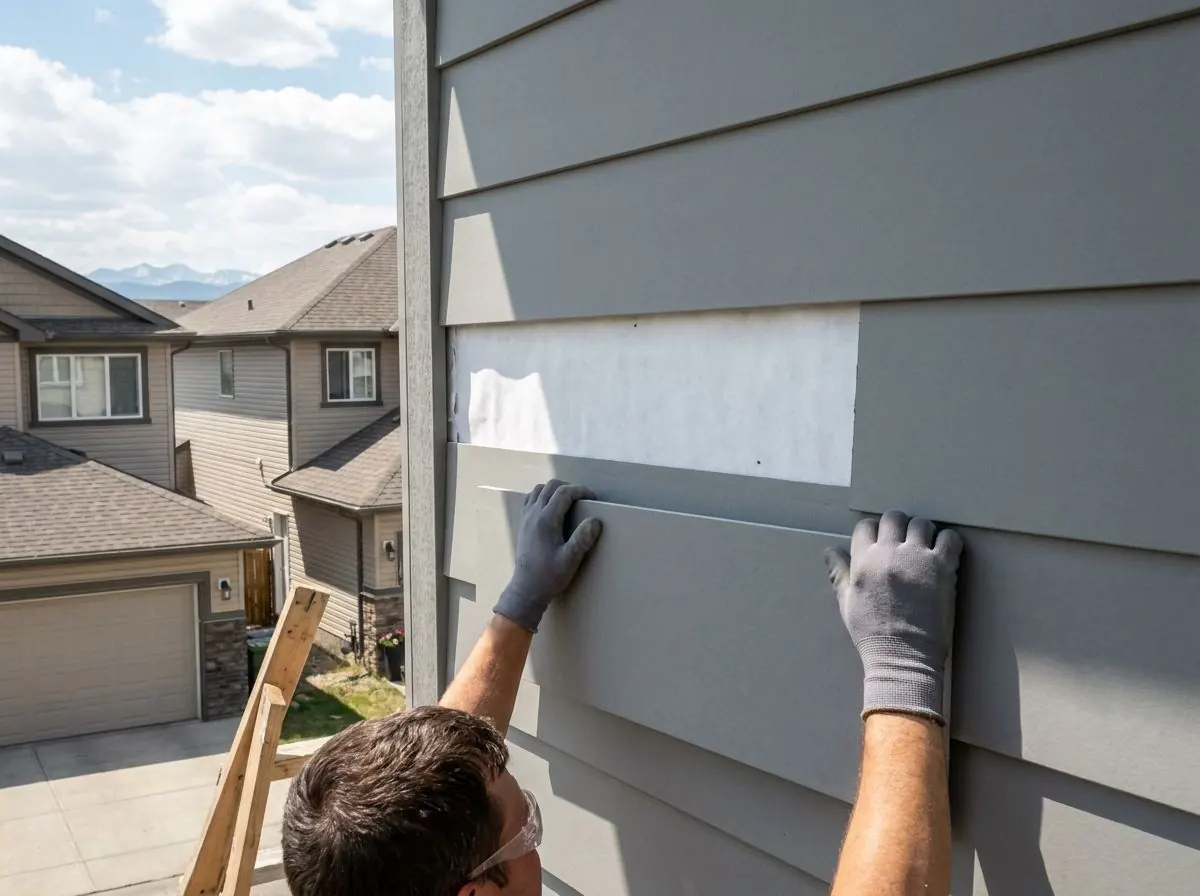
The Problem It Solves
Fibre cement is a hard, stable board, so its failures usually trace back to installation or to an event rather than to the product wearing out. A plank installed tight to a deck or buried in landscaping soaks at the bottom edge until the paint lets go and the edge swells or flakes. Boards face-nailed and over-driven crack at the fastener. Butt joints with no joint flashing behind them send water onto the wall. Lap plank used as fascia or trim is a use James Hardie’s instructions specifically rule out. And hail, a mower or a ladder simply breaks boards.
The second problem is appearance. A replacement board has to sit in a wall that has been in the sun for years. ColorPlus is a factory-applied, oven-baked finish, and a new ColorPlus board may look slightly different beside a weathered elevation. Primed boards painted on site age with their paint, so matching them means matching the paint rather than the board. Availability adds another layer: profiles, textures and colours depend on the dealer, and a board that was stocked when the house was built may not be stocked today.
Many Calgary houses mix materials, with fibre cement on the front and vinyl on the sides and back, so a repair visit often covers both. Damaged vinyl has its own causes: panels nailed tight can’t move with temperature, so they buckle or crack, and replacement panels from a newer production run may not match faded originals. The thread running through all of it is simple. Swapping a broken board without asking why it broke means paying for the same repair again in a few seasons.
How It Works
Sectional repair is a recognized procedure. James Hardie’s Canadian HardiePlank instructions reference a technical bulletin covering an exemption from their nailing rules when doing a repair, which is what allows a single course to be replaced without stripping the wall above it. We remove the damaged board, check the building paper or house wrap and the sheathing behind, replace any damaged joint flashing, and install the new board to James Hardie’s published installation instructions. Fibre cement dust contains respirable crystalline silica, and James Hardie ranks a saw with vacuum dust collection as the best way to cut it and says not to dry-sweep the dust.
For ColorPlus walls, James Hardie’s instructions allow small nicks to be touched up sparingly with its touch-up applicator, and say to replace the damaged area if large areas need touch-up. Third-party touch-up paint isn’t covered by the ColorPlus limited finish warranty, so we don’t patch a baked finish with store paint and call it matched. When a new board won’t blend with a weathered wall, repainting the elevation corner to corner sometimes gives the better result. Primed boards are painted in 100% acrylic. Before we leave, the cause is corrected: clearance restored, kickout flashing added, or joint flashing installed.
How the Job Runs, Step by Step
Read the failure pattern
We look at where and how boards failed before touching them. Swollen bottom edges point to clearance, cracks at nail heads point to fastening, staining at butt joints points to missing joint flashing, and damage in a line below a roof points to a missing kickout flashing.
Identify product and finish
We identify the profile, texture and finish, and whether the wall is ColorPlus or site-painted. Then we confirm with the dealer what is still available, so the plan is built on boards we can actually get rather than a guess.
Remove and look behind
Damaged boards come out with the surrounding courses protected. With the wall open we check the membrane, joint flashing and sheathing. If the sheathing is soft, the job becomes a sheathing repair, and we tell you before going further.
Install and correct the detail
New boards go in with the lap, fasteners and joint treatment the product calls for, and cut edges sealed. The underlying fault is fixed at the same visit: clearance to grade, deck or roof restored, Z-flashing gapped, kickout flashing added.
Blend the finish
ColorPlus nicks get the manufacturer’s applicator, sparingly. Primed boards are painted within the manufacturer’s painting window. Where a patch will stand out, we show you before recommending a full-elevation repaint, so the decision is yours.
What Decides the Specification
Clearances drive the repair specification, because they cause the most repeat failures. James Hardie’s Canadian instructions call for 203 mm (8 in) between the ground and the siding, at least 50 mm (2 in) to roofs, decks, slabs, paths and steps, 25 mm (1 in) to gutters, and a gap of at least 6 mm (¼ in) above horizontal Z-flashing that is left uncaulked. They also say the boards must not remain in contact with standing water. A board that failed sitting tight to a deck will fail again in the same spot, so a proper repair can mean trimming boards up, lowering landscaping or reworking a flashing.
The second driver is how the original wall was built. James Hardie prefers blind nailing, allows face nailing only where required by code for high-wind areas, and says the two must not be used together, which is why its repair exemption matters. Butt joints can be treated with joint flashing, which James Hardie recommends; with caulk, which it doesn’t recommend on ColorPlus for aesthetic reasons; or with an H-jointer. Where planks go directly against the wall, the Canadian product evaluation calls for asphalt-impregnated building paper behind them, not a synthetic wrap. The repair follows the detail the wall should have had.
Alberta Code Notes
Replacing a few damaged boards with the same product is maintenance, which generally fits the Alberta Permit Regulation’s exemption for re-siding with a similar type of siding and no structural change. If a repair uncovers rotted sheathing or framing, that condition may no longer be met, and the authority having jurisdiction decides; the Town of Okotoks, for example, exempts minor exterior repairs that don’t affect structural integrity. Near property lines, the cladding has to suit the limiting distance. The Canadian HardiePlank instructions state the product is non-combustible when tested to CAN/ULC-S114, with a flame spread rating of 0, though James Hardie notes that fire resistance doesn’t extend to applied paints or coatings.
General guidance only. The authority having jurisdiction and the product’s own evaluation report decide what applies to your job.
Around Calgary
Fibre cement repair in Calgary concentrates on homes built from the 2000s onward, when builders commonly added Hardie accents to front elevations and used vinyl elsewhere. Communities such as Rocky Ridge in the northwest and Auburn Bay in the southeast tend to show that mix, while newer building-out areas carry more full fibre cement exteriors. Calgary’s freeze-thaw cycles find weak spots: the City of Calgary’s climate-ready guidance notes that water can accumulate through freezing and thawing and damage fibre cement that isn’t kept painted. Hail adds the rest, with the August 2024 storm across northern Calgary a recent source of cracked boards.
Often Done Alongside
Calgary Hail Damage Hardie Board & Siding Replacement
Storm-damaged siding documented, removed and replaced after Calgary hail.
Dry Rot & Substrate Sheathing Restoration
Rotted OSB, plywood and studs replaced, and the water source traced and fixed.
HardieTrim & ColorPlus Architectural Banding
Fibre cement corners, casings, bands and frieze in primed or ColorPlus finish.
Where We Do This Work
Siding Repair: Questions We Get
Can you match my existing Hardie board colour?
Why did my Hardie board crack?
Can one plank be replaced without removing the whole wall?
Do you repair vinyl siding panels too?
How do you work out what my walls actually need?
Considering Siding Repair?
Call Calgary Siding Solutions or send the details. We will look at the job, tell you whether siding repair is the right fix, and price it in writing.