Vinyl Siding Installation and Replacement for Your Home
Vinyl siding in Calgary for houses whose original builder-grade panels have faded, rippled, cracked or blown loose. We re-side with thicker premium panels, repair the weather barrier behind them, and hang every course loose so it can move through our temperature swings instead of buckling.
The Problem It Solves
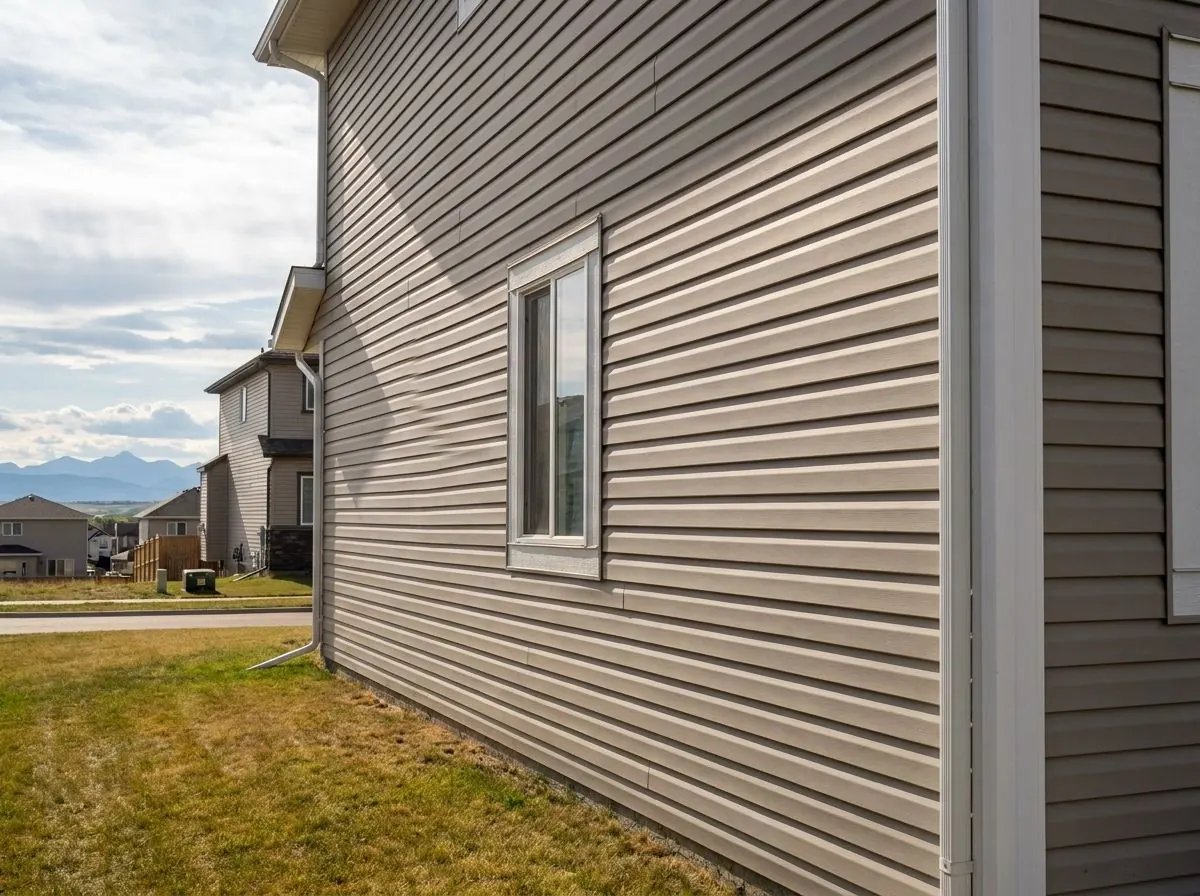
Where a 1990s or 2000s Calgary house still has its original builder-grade vinyl, the wall tends to show it: thin panels, sun-faded on the south and west elevations, with ripples running across the courses. Entry vinyl lines sold in Canada today run around .040 inch thick. Where panels were nailed tight they had nowhere to go when they expanded on a hot afternoon, so they bowed. Vinyl also gets stiffer and less forgiving of impact in cold weather, which matters in a freeze-thaw climate like Calgary’s.
Hail is the bigger story. The City of Calgary’s climate-ready guide says vinyl siding is not recommended here, while acknowledging it is the least expensive and most common siding material in the city. Its reasoning is blunt: cheaper vinyl can be easily damaged by hail and extreme heat, and can crack with fluctuating weather. The June 2020 storm left northeast Calgary homes stripped of siding or punched full of holes, and reporting on the August 2024 storm described winds shredding vinyl across northern Calgary. Every hole is a route for water to reach the membrane behind.
Then comes the patching. Vinyl profiles and colours get discontinued, and weathered panels fade, so a new panel slotted in after a storm rarely matches the wall around it. Behind the panels, the original housewrap may be torn at corners or missing flashing above windows. Some Alberta home policies also carry a roof-and-siding endorsement that settles vinyl siding claims on an age-adjusted basis rather than full replacement cost, which can leave owners deciding whether to re-side the whole house rather than patch it again.
How It Works
Premium vinyl solves the problems that come from thin panels and poor hanging, and it is honest to say it solves little else. Premium lines are thicker, generally in the mid-.040-inch range, which makes each panel stiffer, keeps long runs straighter and reduces the waviness of builder-grade walls. Thickness does not make vinyl hail-resistant. The bigger gains come from installation: the industry installation manual notes vinyl can expand and contract half an inch or more over a 12 foot 6 inch length, so every panel has to slide freely on its fasteners. Hung that way, a wall has room to stay flat in July and in a January cold snap.
A re-side is also the one chance in decades to fix what is behind the siding. The City of Calgary advises having the weather-resistive barrier inspected, repaired or replaced when siding comes off, and we treat that as part of the job. With the old panels stripped we can see torn membrane, missing head flashing and soft sheathing, and deal with them before anything is covered again. Vinyl stays the lightest cladding on the wall, and a single damaged course can be unlocked and replaced without disturbing its neighbours.
How the Job Runs, Step by Step
Strip the old panels and read the wall
We remove panels, starter strip, J-trim and corners down to the membrane so every elevation can be read. Stains on the sheathing, torn wrap and soft spots under windows show where water has been getting in and what needs repair first.
Repair membrane and flashing
Torn sheathing membrane is replaced and lapped at least 100 mm, upper sheets over lower. Flashing goes above openings and at horizontal junctions where the code calls for it, and sealant goes between trim and window frames, never between panels and receivers.
Establish a flat, level plane
Vinyl shows every hollow behind it. Where the old wall is uneven we fur it out or remove the uneven original material, as the installation manual allows, then snap a level line so the starter strip and every course above it run true.
Hang every panel loose
Fasteners go in the centre of the slots, no more than 16 inches apart, heads left a dime’s thickness proud. We leave at least 1/4 inch at openings and stops, 3/8 inch below 4.4 °C, and never face-nail or staple through panels.
Trim out, tie in and slide-test
Corners, J-trim and the soffit junction are finished so water sheds outward. Before leaving, we slide sample panels on each elevation by hand to confirm they move freely, and suggest keeping a few spares from the same run for future repairs.
What Decides the Specification
Thickness is the first decision, and it is measured in inches, not gauge. Gauge is a steel term; vinyl is sold by nominal thickness in thousandths of an inch. One Canadian manufacturer’s 2025 comparison guide runs from .040 inch on its entry line to .050 inch on a board-and-batten profile, with premium lap lines at .044 and .046 inch. A thicker panel holds a straighter line, which matters most on long two-storey side walls and on exposed lots where wind works the panels. We confirm the wind-load certification label before ordering.
Profile and colour are driven by the house and by what can still be matched. If only some elevations are damaged, we check whether the original profile and colour are still made before recommending a partial job. Wall condition sets how much furring or substrate repair is needed. Location sets hard limits: a wall close to the property line may not be allowed to carry vinyl without a specific assembly. And where a home sits in a repeatedly hit hail area, we talk through tougher claddings or insulated vinyl before quoting plain vinyl.
Alberta Code Notes
Alberta currently enforces the National Building Code – 2023 Alberta Edition. Its Part 9 requires vinyl siding to conform to ASTM D3679; the older CAN/CGSB-41.24 standard survives only in a Part 5 table. At a limiting distance under 1.2 m from a property line, vinyl is allowed only in specific assemblies, such as a thin, low flame-spread panel over gypsum sheathing on a fire-rated wall, so we confirm the limiting distance first. Under Alberta’s Permit Regulation, replacing siding with a similar type, for maintenance or appearance and with no structural change, is generally exempt from a building permit. Structural repairs or altered openings can change that. The City of Calgary treats exterior renovations case by case, Cochrane’s overview list shows replacing siding as not needing a permit, and elsewhere we confirm with the municipality first.
General guidance only. The authority having jurisdiction and the product’s own evaluation report decide what applies to your job.
Around Calgary
Most of our vinyl work is on the suburbs that ring the city. Near our base in Evergreen, a community largely built through the 2000s, a house with builder vinyl and stone or Hardie accents on the front tends to show fading, ripples and mismatched patch panels first on the side and rear walls. In Shawnessy, built largely through the 1980s and 1990s, any original vinyl has had more summers to fade and stiffen, and tired wood fascia beside it is worth capping at the same time.
In the northeast the driver is hail rather than age. Saddle Ridge, largely built through the 2000s, is named among northeast Calgary’s hail-affected neighbourhoods, in the quadrant where the June 2020 storm concentrated its worst damage. For owners there, a full re-side in a thicker panel over a repaired membrane is a sensible reset, but we are candid that vinyl will still take damage in a severe storm and that other claddings deserve a look.
Often Done Alongside
Insulated Vinyl Siding Systems
Foam-backed vinyl: a stiffer face and a modest, tested R-value.
Weather-Resistive Barrier (WRB) & Housewrap
Tyvek, building paper or self-adhered membrane, lapped, taped and flashed.
Vented & Solid Aluminum Soffit Installation
Vented and solid aluminum soffit for attic airflow, hail repairs and sagging eaves.
Where We Do This Work
Vinyl Siding: Questions We Get
Is thicker premium vinyl hail-resistant?
What does “heavy-gauge” vinyl actually mean?
Do I need a permit to replace vinyl with vinyl?
Can you replace only the hail-damaged panels?
Can siding be installed in a Calgary winter?
Considering Vinyl Siding?
Call Calgary Siding Solutions or send the details. We will look at the job, tell you whether vinyl siding is the right fix, and price it in writing.