Siding for SW Calgary, from Killarney to Evergreen
Southwest Calgary is home turf for us, and it has the widest spread of house ages of any part of the city we work in. A post-war bungalow in Killarney, a two-storey in Shawnessy and a house in still-growing Aspen Woods each hide a different wall behind the siding, and the decade a home went up is the best first clue to what we will find when the old cladding comes off.
At a Glance
- Permits issued by
- City of Calgary
- From our Evergreen office
- Home base, Evergreen SW
- Postal prefixes
- T2T, T2V, T2W, T2Y, T3E, T3H
The Homes and Buildings in Southwest Calgary
The inner southwest is the oldest stock we work on. The City of Calgary classes Killarney/Glengarry and Richmond as 1950s communities, and their post-war bungalows were commonly finished in stucco, wood siding or an early aluminum over-cladding. Behind that, the sheathing is often boards rather than OSB, walls can be out of plane after decades of settling, and there may be rot where water got past old patches. James Hardie’s installation instructions warn that irregularities in framing and sheathing can mirror through the finished siding, so on these houses we budget time to repair and true the wall before anything new goes on. Next door in Altadore and South Calgary, around Marda Loop, originals sit beside modern infills in board and batten, metal panels and stone.
The middle ring is a different job. Canyon Meadows carries the City’s 1960s–1970s label and tends to have aluminum, cedar and stucco. Shawnessy, Somerset, Woodbine and Signal Hill are 1980s–1990s communities, where early vinyl, stucco, cedar accents and wood fascia are the usual mix. Here the complaints are faded, brittle vinyl, fascia boards that need painting every few years, and first-generation house wrap details at windows. Because the whole wall is exposed during a full re-side, this is the age group where adding exterior insulation makes the most sense to discuss.
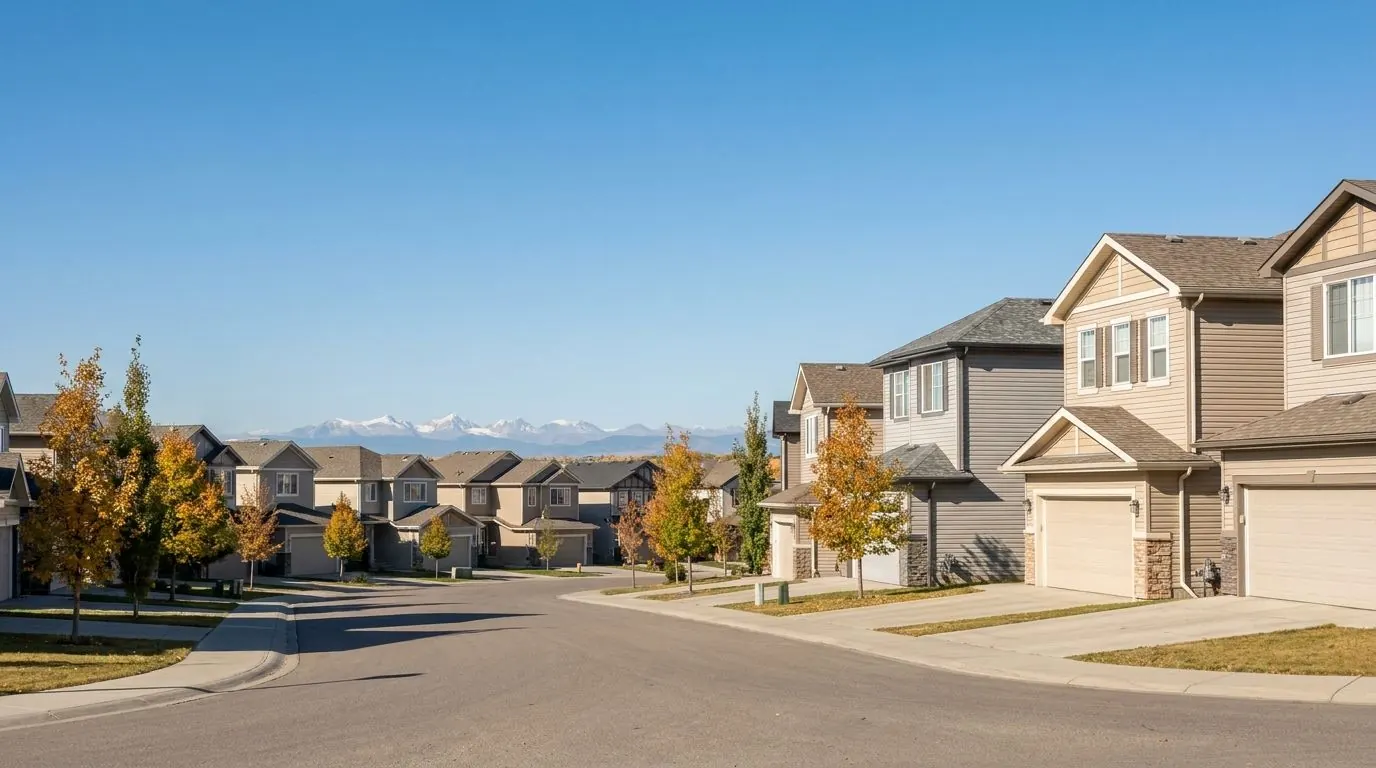
The newer southwest starts in Evergreen, where our office is, and Bridlewood, both largely built through the 2000s. Builder vinyl with stone or Hardie accents on the front elevation is the common pattern, so the work is replacing hail-cracked panels, matching colours that have faded, and fixing stone wainscots installed without a weep screed or buried in landscaping. Aspen Woods is still building out, with estate and move-up homes in stone, Hardie board, stucco and metal accents, where repairs have to match an existing finish.
Neighbourhood Notes
Evergreen
Our home community, largely built through the 2000s. Builder vinyl with stone or Hardie accents on the front is typical, and the usual calls are hail-cracked side walls and replacement panels that no longer match the originals.
Bridlewood
Another 2000s community with builder vinyl and stone accents. We look closely at the base of stone wainscots, where missing weep screeds and soil piled against the veneer let water sit behind it.
Shawnessy and Somerset
Both carry the City’s 1980s–1990s label. Early vinyl, stucco and wood fascia are common, so a re-side here often pairs new siding with aluminum fascia capping and a fresh weather barrier.
Signal Hill
A 1980s–1990s community where larger homes often mix stucco and vinyl with cedar accents. Weathered cedar can be replaced board for board or converted to fibre cement that keeps the look without the staining cycle.
Aspen Woods
Still building out, with estate and move-up homes in stone, Hardie board, stucco and metal accents. Repairs here are about matching an existing profile and finish, and we confirm product availability before quoting.
Killarney/Glengarry and Richmond
Post-war bungalows from the City’s 1950s era, many with stucco, wood or aluminum over board sheathing. Expect sheathing repairs and wall straightening before new cladding, and new infills going up alongside.
Altadore and South Calgary
The Marda Loop area mixes originals with modern infills. Where a wall sits close to the property line, the code limits what cladding can go on it, and non-combustible fibre cement or metal is the straightforward choice.
Canyon Meadows and Woodbine
Canyon Meadows is a 1960s–1970s community with aluminum, cedar and stucco; Woodbine followed in the 1980s–1990s with early vinyl and cedar. Both are good candidates for a full re-side with exterior insulation.
Permits in Southwest Calgary
Authority having jurisdiction: City of Calgary
The City of Calgary is the authority for every southwest address, from Richmond to Evergreen. Alberta’s Permit Regulation exempts re-siding done to maintain a home or improve its looks when the new siding is of a similar type, nothing structural changes and health or safety is not at risk. Calgary’s own renovation page, however, lists exterior renovations among work that can need a building permit without spelling out how that applies to a straight siding swap, so we confirm with the City first. For older inner-city houses there is one more point: the Land Use Bylaw says adding exterior insulation and its cladding to an existing building does not need a development permit, and lets it project up to 0.3 m into a required setback, but buildings on the City’s inventory of evaluated historic resources are not covered by that exemption. Building-code approval is a separate question again.
What Southwest Calgary Homes and Buildings Need Most
HardieBoard Vertical Board & Batten
HardiePanel vertical siding and HardieTrim battens over a furred cavity
Corrugated & Standing Seam Metal Siding
Corrugated, ribbed and standing seam steel or aluminum panels for walls.
Continuous Exterior Rigid Insulation (CI)
Rigid foam or stone wool over the sheathing to stop heat escaping through the studs.
Dry Rot & Substrate Sheathing Restoration
Rotted OSB, plywood and studs replaced, and the water source traced and fixed.
Manufactured Stone Veneer & Masonry Accents
Cultured and stacked stone wainscots, pillars and entries, detailed to drain.
Western Red Cedar & Natural Wood Siding
Western red cedar lap, tongue-and-groove, shingles and board replacement.
Close to Southwest Calgary
Siding in Southwest Calgary: Questions
Can the stucco on my 1950s Killarney bungalow be replaced with Hardie board?
Is it worth adding exterior insulation to an older southwest home while the siding is off?
Did the August 2024 hailstorm hit southwest Calgary?
Siding Work in Southwest Calgary?
Call or send the details. Calgary Siding Solutions works from Calgary, and we will tell you what the job needs before we price it.