Foam-Backed Insulated Vinyl Siding for Cold Winters
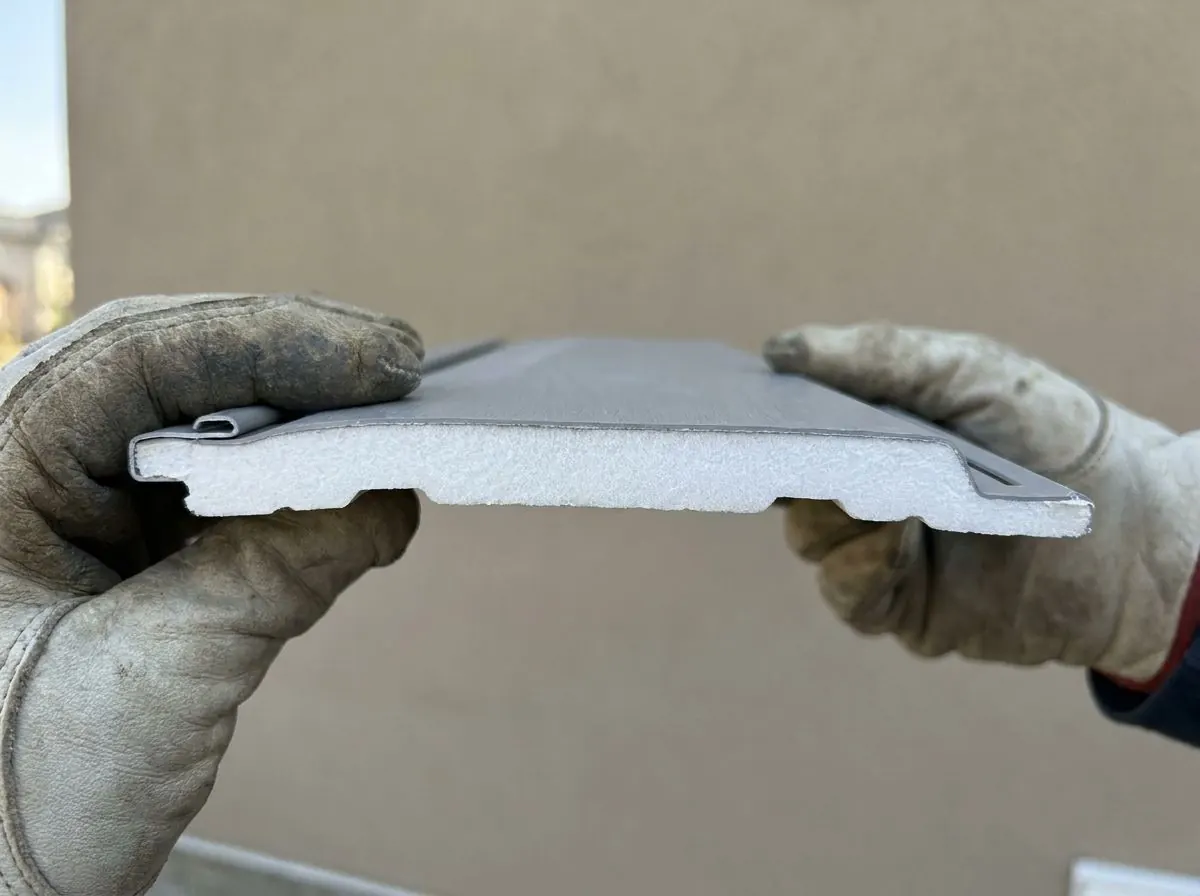
Insulated vinyl siding in Calgary puts a bonded foam backer behind each vinyl panel. The foam stiffens the face and adds a modest, tested amount of insulation across the wall. We install it during full re-siding projects and are straight with you about what that foam can and cannot do.
The Problem It Solves
Owners replacing hail-damaged or worn-out vinyl often want vinyl again, but something that feels less flimsy and does a bit more for a cold wall. Standard vinyl is a hollow shell: the profile stands off the wall, and a hailstone or a ladder leaning on it has nothing behind it to push against. The City of Calgary’s guide is plain that cheaper vinyl is easily damaged by hail. Insulated vinyl answers that by filling the hollow behind the panel with foam.
The trouble starts with the numbers that get attached to it. Insulated vinyl is sometimes sold with claims of R-3 to R-5, and those figures do not hold up. The standard for this product sets a tested minimum of R-2.0, and the products sold in Canada typically land between roughly R-2 and R-3.5. No R-5 insulated vinyl was found for sale here. An owner expecting a major energy upgrade from a sales sheet is likely to be disappointed.
The third problem is the wall itself. In a wood-frame wall the studs bridge straight through the cavity insulation, and on an older house the wrap behind the original siding is often tired. Insulated vinyl covers the studs with a thin layer of foam, which helps a little, but it does nothing for air leaks, a torn membrane or a missing window flashing. If those are left alone, the new foam-backed panels simply cover the real problems.
How It Works
The foam backer does three honest jobs. It supports the face of the panel, so the wall feels more solid and the face is better supported against impact; the City of Calgary credits insulated vinyl with some impact resistance against hail and high winds. It also runs across the face of the studs and sheathing, so it adds a thin layer of insulation over the framing rather than only between it. That layer is interrupted at corners, windows, doors and trim, so it is fair to call it a modest thermal break, not a continuous blanket. And its R-value is tested: certified product has its value determined by ASTM C1363 hot-box testing.
What it cannot do is replace real exterior insulation. A single inch of Type 1 EPS board is rated R-3.75, already more than most insulated vinyl panels, and rigid boards come in several inches of thickness. If lower heating demand is the goal, continuous exterior rigid insulation under new siding does far more. Insulated vinyl fits the owner who is re-siding anyway and wants a stiffer, slightly warmer vinyl wall. On acoustics, we have no tested noise-reduction figure for these panels, so we do not sell them as a soundproofing product.
How the Job Runs, Step by Step
Agree on the goal first
We ask what you want from the wall: better impact resistance, a straighter face, lower heating demand, or all three. If energy is the main goal, we price exterior rigid insulation alongside insulated vinyl so you can compare honestly before choosing.
Strip, inspect and repair
Old siding comes off, and we check the sheathing and membrane. Damaged membrane comes out and new membrane goes on with laps of at least 100 mm, and head flashing and sill details are corrected, because the foam backer does nothing for water that gets past the panels.
Match trim to the thicker panel
Foam-backed panels sit further off the wall than hollow vinyl, so corners, J-trim and window surrounds are chosen to suit the panel depth. Starter strips come from the same system, such as the EasyStart strip in one Canadian manufacturer’s guide.
Hang panels to move
The foam does not stop vinyl from expanding and contracting, so panels are fastened in the centre of the slots and left free to slide. We follow the manufacturer’s foam setback at panel ends.
Record the tested R-value
We keep the product label showing the certified R-value and the product line, and hand it over with the job. It gives you a real number for any future energy assessment instead of a figure from a brochure.
What Decides the Specification
Product availability drives the choice more than it does for plain vinyl. Insulated vinyl is a niche product in Alberta, and the range a dealer can supply changes. Kaycan’s Montebello Insulated Log Siding is one line sold in Canada, and Kaycan’s installation guide sets the foam back 3/4 inch from the panel ends on horizontal insulated siding. We confirm which profiles, colours and matching accessories are actually available before quoting, and we compare the certified R-value printed on each product rather than the highest number in the marketing.
The other driver is how far the wall upgrade should go. If the goal is a tougher vinyl face with a small insulation gain, insulated vinyl over a repaired membrane is a sensible specification. If the goal is a real cut in heat loss, the specification changes to rigid insulation boards over the sheathing, with furring and conventional cladding on top. That route brings its own rules on board thickness and fastening, and it can change how the municipality views the project, so it is scoped as a different job.
Alberta Code Notes
Alberta currently enforces the National Building Code – 2023 Alberta Edition. Its Part 9 requires insulated vinyl siding to conform to ASTM D7793, and industry guidance says certified insulated siding shows a tested value of R-2.0 or greater. The City of Calgary requires houses whose building application was submitted on or after November 1, 2016 to have renovations comply with the Section 9.36 energy rules, and all renovations must use components that perform as well as, or better than, what they replace. The code also sets how thick foam boards over sheathing must be relative to the cavity insulation, so the sheathing stays warm enough to stay dry; its explanatory note treats vinyl with a drained and vented space behind it differently, and we confirm the assembly on each job.
Alberta’s Permit Regulation exempts re-siding with siding of a similar type when no structural change is involved, but adding exterior insulation is one of the changes that can take a job outside that exemption. Whether foam-backed vinyl replacing standard vinyl counts as similar is for the authority having jurisdiction to decide, whether that is the City of Calgary, Airdrie, Okotoks, Cochrane or Chestermere, so we confirm before work starts.
General guidance only. The authority having jurisdiction and the product’s own evaluation report decide what applies to your job.
Around Calgary
Insulated vinyl makes the most sense in northeast Calgary, where owners of vinyl houses have lived through major hailstorms and want their next wall to stand up better. Taradale, largely built through the 2000s, and Martindale, built largely through the 1980s and 1990s, are both named among the northeast communities affected by hail. Owners there who like the look of vinyl, but want a stiffer face with foam behind it, are the natural fit, provided they accept that no vinyl is immune to severe hail.
Airdrie is the other place it comes up. The Insurance Bureau of Canada named Airdrie among the areas hit by the June 2020 storm, and the August 2014 storm struck Airdrie and surrounding areas before that. Where vinyl panels on an Airdrie house need replacing, owners can step up to foam-backed panels without changing the look of the street. Airdrie, like Calgary, falls in climate zone 7A, so a small insulation gain is welcome, if modest.
Often Done Alongside
Premium Heavy-Gauge Vinyl Siding
Thicker vinyl panels, hung loose to ride out Calgary’s temperature swings.
Continuous Exterior Rigid Insulation (CI)
Rigid foam or stone wool over the sheathing to stop heat escaping through the studs.
Weather-Resistive Barrier (WRB) & Housewrap
Tyvek, building paper or self-adhered membrane, lapped, taped and flashed.
Where We Do This Work
Insulated Vinyl: Questions We Get
How much R-value does insulated vinyl really add?
Will insulated vinyl lower my heating bills?
Is insulated vinyl quieter than regular vinyl?
Does insulated vinyl stand up to hail better?
How do I know the siding was installed properly?
Considering Insulated Vinyl?
Call Calgary Siding Solutions or send the details. We will look at the job, tell you whether insulated vinyl is the right fix, and price it in writing.