Fibre Cement Trim Boards in Factory-Finished Colours
HardieTrim boards and James Hardie’s ColorPlus factory finish for Calgary homes: corner boards, window and door casings, horizontal bands and frieze lines in fibre cement, installed to James Hardie’s published installation instructions alongside your new siding.
The Problem It Solves
A fibre cement re-side is judged at its edges. The planks can be perfect and the house still looks half-finished if the corners, window casings and the line under the eaves are left in whatever trim was there before. Where a Calgary home went to Hardie board on the front elevation only, the trim around those planks may be painted wood or a builder-grade profile. It ages on its own schedule, so the siding can look fine while the casings beside it peel or split at the mitres.
The horizontal pieces are the risky ones. A band board at the floor line or a frieze board below the soffit is a ledge, and snowmelt and rain sit on a ledge. If nobody flashed the top of it, water finds the joint between the band and the siding above, runs down behind the board and wets the sheathing where nobody can see it. Trim that is only caulked along the top relies on a bead of sealant to do a flashing’s job.
Then there is colour. When the siding carries James Hardie’s factory-baked ColorPlus finish and the trim is brush-painted on site, the two rarely read as one wall. They can drift further apart as the wall weathers. Homeowners also discover that ColorPlus has limits on repair: small nicks take the manufacturer’s touch-up, but larger scuffs mean replacing the board.
How It Works
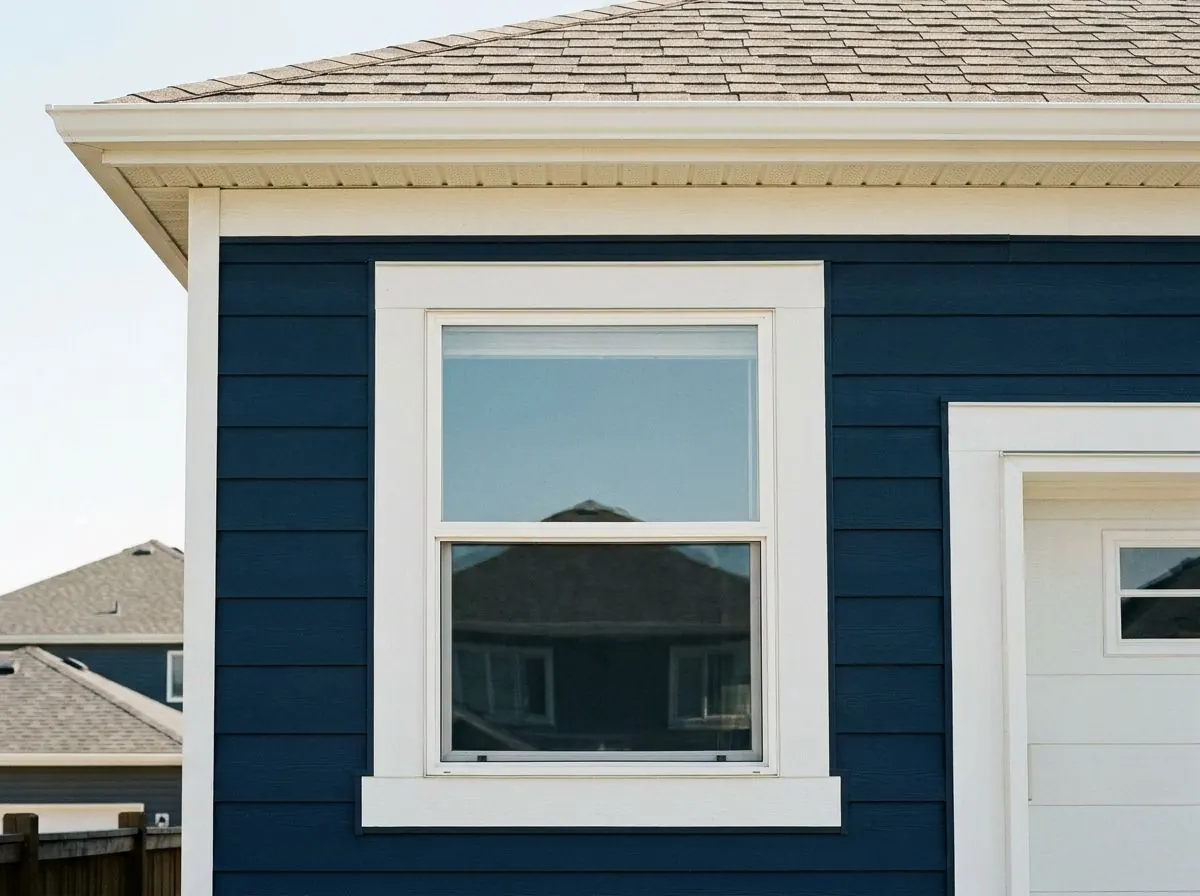
HardieTrim is made from the same fibre cement family as the planks and panels it frames, as boards intended for frieze, rake, window, door and corner details. It comes in two thicknesses. The 5/4 board, at 25 mm, stands proud of lap siding and throws a real shadow line at corners and casings. The 4/4 board, at 19 mm, suits flatter details. Thickness is not only a looks decision: James Hardie’s Canadian shingle instructions call for trim at least 1 in thick where HardieShingle panels butt it, because the panels stack roughly 23 mm deep.
The finish is chosen at the same time. ColorPlus Technology is James Hardie’s factory-applied, oven-baked finish, and the Canadian HZ5 documents list each product as available with it, subject to dealer availability. When the siding is ColorPlus, ColorPlus trim in a confirmed matching or contrasting colour avoids the site-painted mismatch. Where a custom colour is wanted, PrimePlus boards arrive primed and sealed and take a 100% acrylic topcoat after installation.
The horizontal details are built as water-shedding assemblies rather than decoration. Each band board, and any frieze with wall exposed above it, gets metal flashing over its top edge, tucked up behind the sheathing membrane and sloped out so water drips clear of the face below. Siding above a flashed band is held off the flashing with a small open gap, per James Hardie’s instructions, rather than caulked shut, so anything that does get in can drain back out.
How the Job Runs, Step by Step
Draw the trim schedule
We mark every corner, casing, band and frieze on photos of each elevation and assign a width and thickness to each, so proportions are decided on paper and 5/4 lands wherever shingle panels or deep reveals need it.
Confirm finish and stock
ColorPlus colours, widths and 10 or 12 ft lengths are checked with the dealer for both siding and trim before ordering. Length decides where frieze joints fall, so we keep them off the main sightlines.
Flash before trimming
Window heads, band boards and frieze lines are flashed first, with each flashing leg lapped under the membrane above and end dams where a flashing stops, so the trim goes on over a wall that already sheds water.
Cut, seal edges, fasten
Boards are cut following James Hardie’s dust-control guidance, which rules out dry sweeping, and every field-cut edge is primed, painted or caulked as James Hardie directs. Boards are fastened to the manufacturer’s trim instructions.
Seal and touch up
Siding-to-casing joints get a non-hardening exterior sealant. On ColorPlus we use James Hardie’s touch-up applicator sparingly, leave nail heads uncaulked, and replace any board with a scuff too large to touch up cleanly.
What Decides the Specification
Board size follows the siding and the house. Lap siding with a generous exposure looks right against wide 5/4 corners and casings; a narrow reveal can take a slimmer board. HardieShingle gables need at least 1 in trim to cover the panel stack, and board and batten walls use James Hardie’s separate 19 mm by 64 mm batten boards rather than cut-down trim. Long frieze lines are laid out around the stock lengths.
Finish follows the siding’s finish and how much future painting you accept. ColorPlus trim beside ColorPlus siding keeps the factory finish throughout, but the colour must be confirmed as available in trim, not just in plank. Primed trim with field paint allows any colour and is simpler to repaint later, at the cost of a repaint cycle. Either way the warranty question is James Hardie’s to answer: see James Hardie Canada’s current warranty for the terms on the boards and on ColorPlus.
Alberta Code Notes
Alberta currently enforces the National Building Code – 2023 Alberta Edition. It requires flashing at every horizontal junction between cladding elements, which is what a band board creates (9.27.3.8.), with limited exceptions. Flashing must extend at least 50 mm up behind the membrane, slope outward at least 6%, have end dams, lap at least 10 mm over the element below and offset its drip at least 5 mm. Flashing over window and door heads is required where the drop from the eave to the top of the trim is more than a quarter of the overhang. Sealant between siding and window or door trim is required unless the joint is fully protected from rain (9.27.4.1.(2)).
James Hardie’s Canadian lap siding is recognized as non-combustible when tested to CAN/ULC-S114, but its own note is worth repeating: fire resistance does not extend to applied paints or coatings, which may be damaged or char in a fire. Trim work done as part of a like-for-like re-side generally sits inside Alberta’s re-siding permit exemption, while a change of cladding type may not; the authority having jurisdiction decides, and we confirm before work starts.
General guidance only. The authority having jurisdiction and the product’s own evaluation report decide what applies to your job.
Around Calgary
HardieTrim work in the Calgary area mostly follows a move to fibre cement. In southeast lake communities such as Auburn Bay and Mahogany, largely built from the 2000s on, a move-up home with Hardie and stone accents on the front and builder trim elsewhere can have its side and rear elevations brought up to match. Where an estate home in Aspen Woods in the southwest already has Hardie throughout, the job is replacing weathered or damaged trim and matching an existing colour.
Where a newer build in Chestermere’s Rainbow Falls and Kinniburgh, or in Okotoks, already has fibre cement, the first question is whether the existing siding is ColorPlus or site-painted, because that decides how new trim is finished.
Often Done Alongside
HardieBoard & HardiePlank Lap Siding
Smooth or wood-grain fibre cement lap planks, laid out course by course
Custom Window & Door Aluminum Capping
Bent aluminum over wood brickmould and bucks, lapped and sealed to shed water.
Decorative Exterior Trim & Mouldings
Corner, frieze and band boards, window surrounds and built-up crown details.
Where We Do This Work
HardieTrim: Questions We Get
Can my new HardieTrim match my existing ColorPlus siding?
Do I need 5/4 or 4/4 HardieTrim?
Does a band board really need flashing if the caulking is good?
What warranty comes with ColorPlus trim in Canada?
How do I know the siding was installed properly?
Considering HardieTrim?
Call Calgary Siding Solutions or send the details. We will look at the job, tell you whether hardietrim is the right fix, and price it in writing.