Cedar Siding Installation and Board Replacement
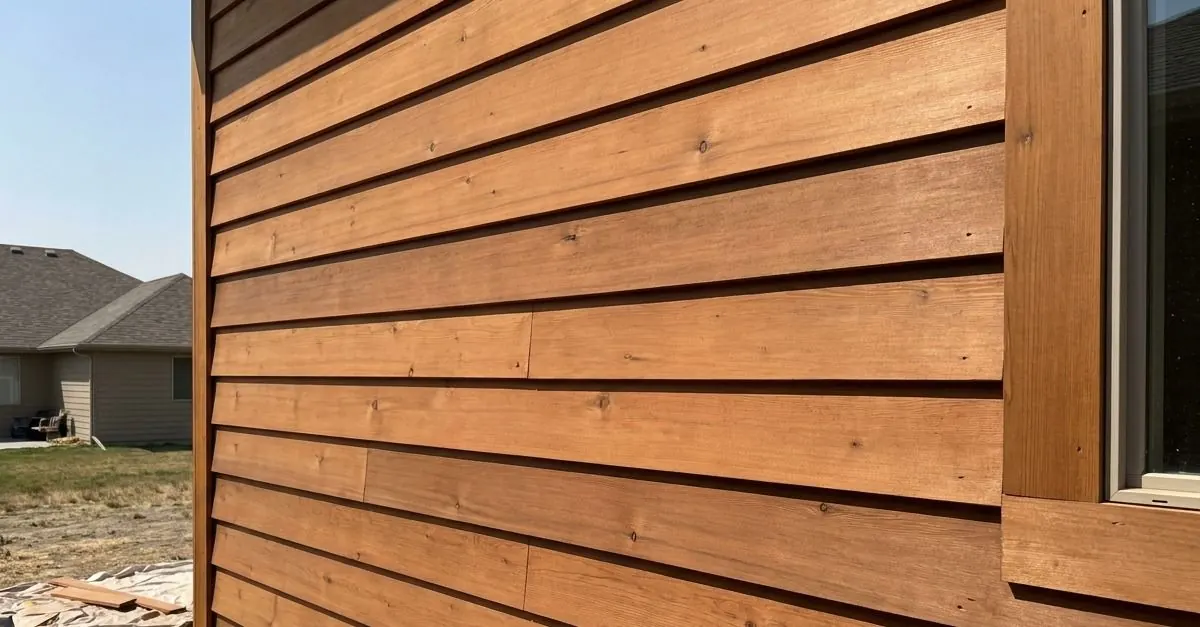
Western red cedar siding for Calgary homes: new lap, tongue-and-groove and channel boards, cedar shingles and shakes, and replacement of split or stained boards on older walls. Every piece is coated on all faces, nailed with the right fasteners and finished for sun, wind and freeze-thaw.
The Problem It Solves
Cedar that was put on a Calgary house decades ago tends to fail in recognisable ways. South and west walls lose their stain first and turn grey and rough. Boards cup, split at the nails or pull loose. Dark streaks run down from every fastener. Down low, boards that sit close to soil, a deck or a roof line soften and stay stained. The City of Calgary’s climate-ready guidance also notes that natural wood siding is prone to damage from wildfire, high winds and hail, so a single storm can add broken boards to a wall that was already tired.
Most of that damage traces back to installation rather than the wood. The Western Red Cedar Lumber Association says ordinary nails can rust, disintegrate and react with cedar’s natural oils, causing stains and streaks, and that copper nails react with cedar too. Boards that were only finished on the face let moisture and extractives work through, which is how stains appear on a light finish. Siding fastened tight over rigid foam with no air space can collect moisture on its back and stain, buckle or shed its finish.
Replacing a few boards brings its own frustration. A new board fresh from the bundle looks nothing like a wall that has weathered for years, so a small repair can stand out more than the damage did. Homeowners are then stuck between a patch that shows, a full elevation refinish they did not plan for, or giving up on cedar altogether when the real issue was how the original boards were detailed.
How It Works
Cedar lasts when it is allowed to move and dry. We follow the Western Red Cedar Lumber Association’s installation guidance: each piece nailed independently so it can move with its moisture content, fastened to studs or furring no more than 24 in apart, with stainless steel nails as the first choice, especially under a transparent stain. Every board is coated on all surfaces, including ends, before it goes up, which helps prevent staining from mildew and extractives. Cut ends are recoated on site, and the bottom end grain of vertical siding gets a water repellent.
Calgary’s dry climate means the building code doesn’t force a rain screen cavity on a house here, but cedar is one cladding where we recommend one. WRCLA advises an air space created with furring strips between siding and rigid foam in severe climates so accumulated moisture can vent, with kiln-dried siding and lighter colours to limit movement. A furred cavity also lets the back of every board dry after a wet spring snow.
Finishing is the part to be honest about. WRCLA’s guidance is that a primer plus two coats of stain gives better service than a single coat of solid stain, applied once moisture content is at or below 20%, with smooth flat-grain faces scuff-sanded first. Even done well, a cedar finish is a maintenance item. Strong sun, drying winds and freeze-thaw cycles wear it, and the walls that get the most sun will need refinishing first.
How the Job Runs, Step by Step
Diagnose why the old boards failed
We look at the fasteners, grade and roof clearances, flashing above windows and at roof-wall intersections, and the condition of the sheathing. Replacing boards without fixing the cause just resets the clock.
Check moisture and coat every face
New cedar is checked for moisture content and coated on all surfaces, ends included, before installation. Under solid stain or paint, that coat is an alkyd oil stain-blocking primer.
Prepare the wall
A lapped sheathing membrane and flashings go on, then furring where we are building a vented cavity. The bottom course is set at least 200 mm above finished ground and 50 mm clear of roof surfaces.
Install board by board
Each board or shingle is nailed on its own with stainless or other corrosion-resistant nails at the required penetration, never through the board below. Shingles and shakes go over sheathing thick enough to hold them, or over wood lath.
Finish and blend
Once moisture content is at or below 20%, the wall gets primer and two coats of stain. Where replacement boards sit among weathered ones, we discuss refinishing the whole elevation so the wall reads as one.
What Decides the Specification
Profile and finish go together. Bevel lap gives the classic horizontal shadow line; tongue-and-groove and channel boards give a flatter, more contemporary face and suit vertical layouts; shingles and shakes add texture to gables or whole walls. A transparent or semi-transparent stain shows the grain but also shows any fastener staining, which is why WRCLA calls stainless nails the best choice under a transparent finish. Solid stain or paint hides more and needs an alkyd stain-blocking primer beneath it. Lighter colours absorb less heat and help limit board movement, particularly over foam.
The wall behind the cedar decides the rest. Over rigid foam, kiln-dried siding on furring with a vented air space is the WRCLA recommendation for severe climates. For shingles and shakes, the code allows fastening to sheathing of at least 14.3 mm lumber or 7.5 mm plywood or OSB; thinner sheathing means wood lath. Location matters too, because cedar is combustible, and a wall close to a property line may not be allowed to carry it at all.
Alberta Code Notes
Alberta currently enforces the National Building Code – 2023 Alberta Edition. Article 9.27.2.4. requires at least 200 mm between finished ground and cladding adversely affected by moisture, such as untreated wood, and at least 50 mm between a roof surface and that cladding. WRCLA’s own guide mentions a smaller ground clearance, but in Alberta the code figure governs. Walls need two planes of protection, although at Calgary’s moisture index of 0.4 the code does not require a capillary break; the furred cavity we recommend behind cedar is our specification, not a Calgary code mandate.
Near property lines, Article 9.10.15.5. is restrictive for wood. Under 0.6 m of limiting distance, wood siding is not among the listed options unless the wall assembly passes the CAN/ULC-S134 fire test. Between 0.6 m and 1.2 m, a 45-minute rated wall may carry certain wood-based claddings with a flame-spread rating of 25 or less after weathering, over 12.7 mm gypsum sheathing on furring no deeper than 25 mm, or an assembly that passes CAN/ULC-S134. On permits, like-for-like board replacement for maintenance generally falls within Alberta’s re-siding exemption, while switching another cladding to cedar is a change of type the municipality may treat differently. We confirm before starting.
General guidance only. The authority having jurisdiction and the product’s own evaluation report decide what applies to your job.
Around Calgary
Cedar is most likely on older Calgary housing. Northwest Varsity and southeast Lake Bonavista grew largely through the 1960s and 1970s, and northwest Edgemont through the 1980s and 1990s; homes from those eras may still carry original cedar lap, shakes or trim. Where they do, the work is usually replacing split and weathered boards, fixing the flashing or clearance problem behind them, and refinishing whole elevations so repairs disappear. West of the city, exposed lots in Cochrane test cedar finishes hard, so furred cavities and a disciplined refinishing plan matter even more there.
Often Done Alongside
Rain Screen & Cavity Ventilation Systems
Furring or drainage mat leaving a drained, vented gap behind the cladding.
HardieShingle Cedar-Look Siding
Cedar-look fibre cement shake panels for gables, dormers and upper walls
LP SmartSide Engineered Wood Siding
Engineered wood lap and panel siding, detailed for Canadian clearances.
Where We Do This Work
Cedar Siding: Questions We Get
How often will cedar siding need refinishing in Calgary?
Can you match new boards to my weathered cedar?
Why are there black streaks running down from my siding nails?
Does cedar siding need a rain screen in Calgary?
Do I need a permit to replace my siding?
Considering Cedar Siding?
Call Calgary Siding Solutions or send the details. We will look at the job, tell you whether cedar siding is the right fix, and price it in writing.