Wood-Look Longboard and Aluminum Siding Installation
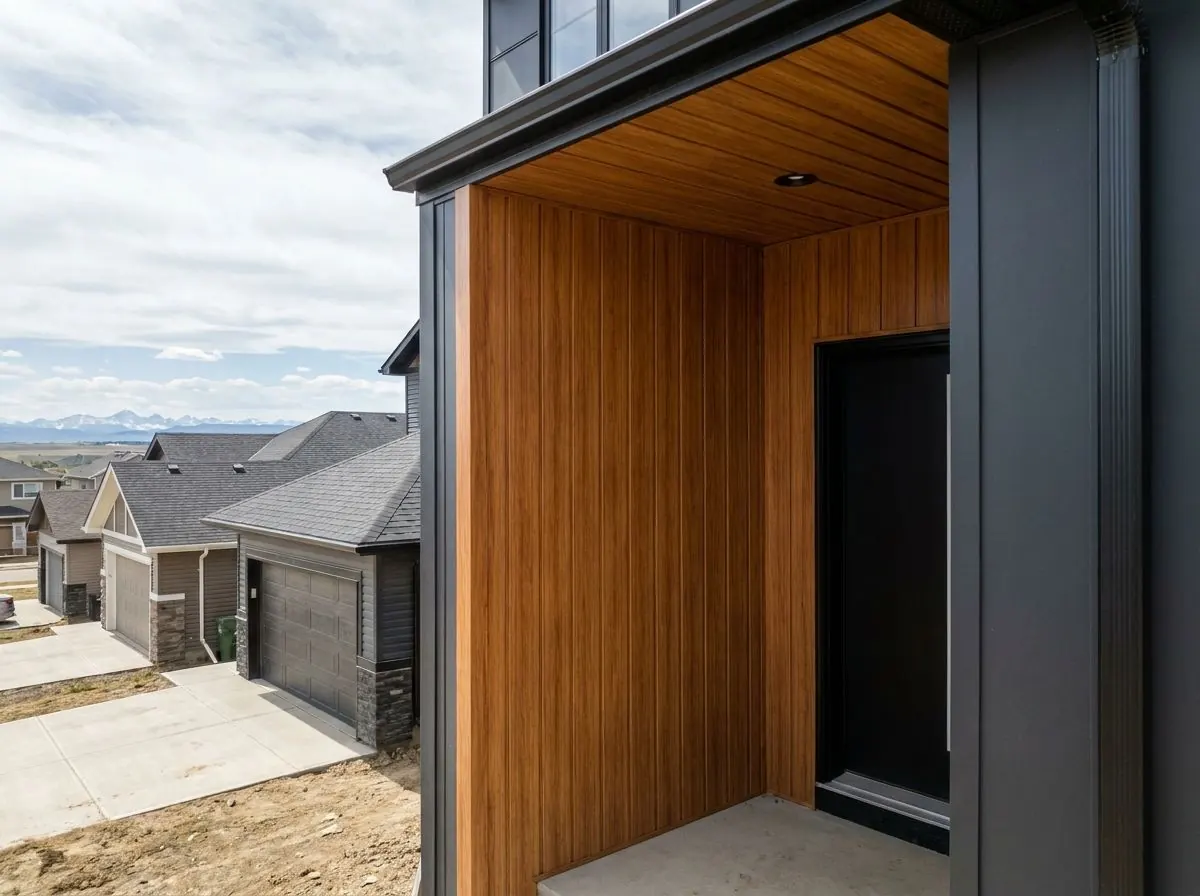
Longboard and architectural aluminum siding for Calgary homes: a wood-grain powder-coated finish on a non-combustible metal plank that dents rather than cracks and skips the staining cycle of real wood. Installed over a flashed, drained wall to the manufacturer’s published instructions.
The Problem It Solves
Plenty of Calgary homeowners want the warmth of a wood exterior, and plenty have lived with what real wood asks for. A cedar feature wall facing south or west loses its finish long before the boards wear out, and the City of Calgary’s climate-ready guidance notes that natural wood siding is prone to damage from wildfire, high winds and hail. The wood-look entry that looked great on the rendering becomes a job to sand, stain and repair on a schedule, in the most visible spot on the house.
Infills and tight suburban side yards add a second problem. Where a wall sits close to the property line, the building code limits what cladding can go on it and may call for a fire-rated wall assembly. Real wood and most wood-look composites are combustible, which rules them out or pushes the design into a tested assembly. Designers who want a warm, natural face on a narrow infill elevation end up choosing between the look they drew and the cladding the code allows on that wall.
Then there is the older generation of aluminum siding. If your house still wears thin, flat-finish aluminum from decades ago, you know its limits: dents from hail and ladders that never come out, a faded finish that rubs off on your hand, and trims bent on site without much thought for how water leaves the wall. Replacing it like for like repeats those weaknesses. What people want is metal’s toughness with a finish and profile that look deliberate.
How It Works
Architectural aluminum plank siding answers both wishes. Longboard, for example, says its façade systems are manufactured in-house from aluminum extrusion to finishing, coated with AAMA 2604/2605 powder coatings that replicate wood grain, stone and aged metal, and tested to meet CAN/ULC-S114 / ASTM E136 non-combustibility standards. There is nothing to rot, split or restain. It is very low maintenance rather than no maintenance: an occasional wash, a look at sealant joints around windows, and prompt attention to anything dented or scraped.
Under hail, aluminum behaves differently from wood or vinyl. The City of Calgary’s guide says hail and wind-driven debris can dent or scratch aluminum siding but will not affect the integrity of your home, and that aluminum does not crack during freeze-thaw cycles. A dent is cosmetic, not a hole in the wall, and on plank systems damaged boards can typically be replaced individually, depending on the system. Behind the metal face we still build the second plane of protection: a lapped sheathing membrane, flashing at horizontal junctions and openings, and flat furring that lets water drain. Open-joint layouts leave gaps by design, so that membrane and flashing do more of the work.
How the Job Runs, Step by Step
Measure limiting distance and choose the system
On infill and side-yard walls we confirm how far the wall sits from the property line before anything is ordered. That, plus the look you want, decides between tongue-and-groove planks, flat panels or an open-joint layout, and which way the boards run.
Strip, inspect and repair the sheathing
Old cladding comes off so we can see the sheathing. Soft or damaged sheathing is replaced, and a new breather-type sheathing membrane goes on with joints lapped at least 100 mm, upper sheets over lower, and taped at windows and doors.
Furring and flashing
Furring at least 19 × 38 mm goes on at no more than 600 mm on centre, shimmed flat so the boards read straight. Flashings slope outward, extend at least 50 mm up behind the membrane, and get end dams and a drip offset.
Starter, boards and trims
Starters are set level and boards go on in the sequence the manufacturer’s published installation instructions describe, with the fasteners, clips and trims that system specifies, leaving the movement allowances it calls for at ends and trims.
Seal, check and hand over
Exterior-grade, non-hardening sealant goes between the cladding and window and door frames. We walk every elevation for straight courses, tight trims and clean penetrations, and leave you the manufacturer’s care guidance for the finish.
What Decides the Specification
The first decision is the system. Tongue-and-groove planks give a continuous board face; flat panels suit a gridded, architectural elevation; an open-joint layout shows deliberate shadow lines. Orientation matters too: vertical boards lift a short entry wall, horizontal boards calm a long garage face. Wood-grain finishes read differently in low winter sun than on a chip indoors, so we choose them outside. We also plan how the aluminum meets what sits beside it, such as fibre cement lap, stone veneer or stucco, so each transition gets its own trim and flashing.
The second decision is the wall behind the boards. The code sends strip aluminum siding to CAN/CGSB-93.2-M and aluminum sheet cladding to CAN/CGSB-93.1-M, at least 0.58 mm thick or 0.46 mm over backing, and the product documentation tells us which applies. If exterior insulation goes on during the re-clad, the cladding must still fasten to framing, furring or blocking rather than foam, with fastener lengths and spacing from the cladding or fastener manufacturer or an engineer. In Calgary, foam outside the sheathing also has to be thick enough relative to the cavity insulation to keep the sheathing warm.
Alberta Code Notes
Alberta currently enforces the National Building Code – 2023 Alberta Edition. For houses, Article 9.10.15.5. sets what can clad a wall near a property line: under 1.2 m of limiting distance, the exposing face needs a 45-minute fire-resistance rating, and metal or non-combustible cladding is one of the listed options. Minor combustible elements such as window trim are permitted if distributed rather than concentrated. Soffits within 1.2 m of a property line must be unvented, and none may project within 0.45 m of it except facing a public way. We measure limiting distance on each job.
Under Alberta’s Permit Regulation, replacing siding with a similar type of siding, for maintenance or appearance and with no structural change, is generally exempt from a building permit. Switching from vinyl, stucco or wood to aluminum plank is a change of cladding type, and adding exterior insulation or altering openings can also take a project outside that exemption. The City of Calgary treats exterior renovations case by case; its Land Use Bylaw exempts added exterior insulation and associated cladding from a development permit, but building-code approval is a separate question. We confirm with the municipality before work starts.
General guidance only. The authority having jurisdiction and the product’s own evaluation report decide what applies to your job.
Around Calgary
Wood-look aluminum suits inner-city infills in southwest communities such as Altadore and South Calgary around Marda Loop, where post-war originals can sit beside newer homes, some finished in metal panel, board and batten or stone. On those narrow lots a side wall may sit close to the property line, and a non-combustible plank can let the wood tone carry around the corner instead of stopping at the front. East of the city in Chestermere the same idea works at an entry, a bump-out or under a covered porch, and on exposed lots in Cochrane, west of Calgary, trims and flashing get extra attention against wind-driven rain and snow.
Often Done Alongside
Corrugated & Standing Seam Metal Siding
Corrugated, ribbed and standing seam steel or aluminum panels for walls.
HardieBoard Vertical Board & Batten
HardiePanel vertical siding and HardieTrim battens over a furred cavity
Rain Screen & Cavity Ventilation Systems
Furring or drainage mat leaving a drained, vented gap behind the cladding.
Where We Do This Work
Aluminum Plank: Questions We Get
Does wood-look aluminum actually look like wood up close?
Will hail damage Longboard or aluminum siding?
How much upkeep does aluminum plank siding need?
Can aluminum siding go on a wall close to my neighbour’s property line?
How do you work out what my walls actually need?
Considering Aluminum Plank?
Call Calgary Siding Solutions or send the details. We will look at the job, tell you whether aluminum plank is the right fix, and price it in writing.